Ragù alla Bolognese vs Spaghetti Bolognese: What Bolognesi Actually Eat
Why Bologna serves ragù on tagliatelle, never spaghetti — the official 1982 recipe, the British dish that copied the name, and where to taste the real thing.
If you’ve spent any time in Bologna and watched a server’s face fall slightly when a visitor asks for “spaghetti bolognese,” you’ve encountered one of Italian food culture’s most documented mismatches. In Bologna itself, ragù — the slow-cooked meat sauce the city is famous for — is almost never served on spaghetti. It’s served on tagliatelle, on gramigna, or layered inside lasagna alla bolognese. This guide is the calm, non-gatekeeping version of why, what the official recipe actually says, and where to taste the real thing on a Bologna food tour or on your own.
The Short Answer
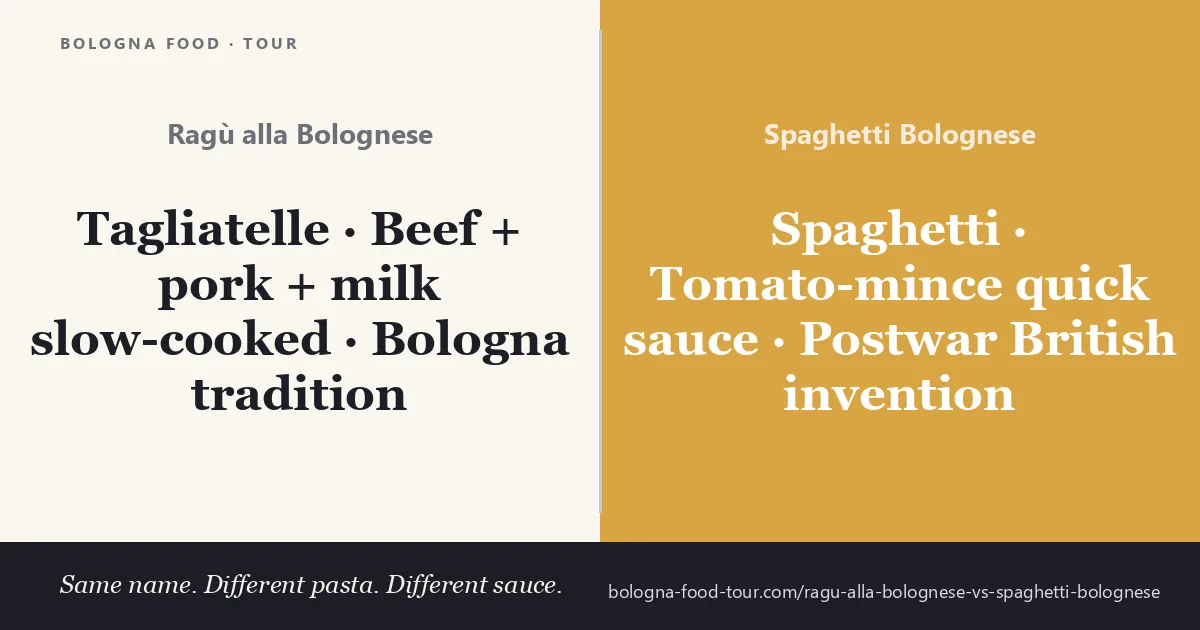
- Ragù alla bolognese is a slow-cooked meat sauce (beef, sometimes with pancetta or pork) traditionally simmered for several hours with a soffritto of onion, carrot, celery, tomato paste, broth, and a small amount of milk and wine.
- In Bologna it is served on tagliatelle (a long, flat, hand-rolled egg-pasta ribbon), on gramigna (a short twisty fresh pasta), or layered in lasagna alla bolognese with béchamel and Parmigiano-Reggiano.
- It is not served on spaghetti in Bologna or anywhere else in Italy. Spaghetti is a long, round, dried wheat pasta — the wrong shape and the wrong tradition for this sauce.
- “Spaghetti bolognese” as a single dish is a non-Italian invention, popularised in postwar Britain and the United States, where dried spaghetti and a fast tomato-and-mince sauce were combined as a convenient family meal. It is not a Bolognese dish, but it is a real dish — just a different one with a borrowed name.
What Bologna Officially Says
In 1982, the Bolognese delegation of the Accademia Italiana della Cucina filed a notarial recipe for “il ragù classico bolognese” with the Bologna Chamber of Commerce (Camera di Commercio di Bologna). It was the city’s formal answer to decades of international interpretations.
The deposited recipe specifies, among other things:
- Beef cartella (skirt or thin flank), coarsely ground
- A piece of pancetta, finely chopped
- A soffritto of carrot, celery, and onion
- Tomato passata or concentrate
- Dry white wine
- Whole milk added during cooking
- Meat broth as needed
- A long, gentle simmer (around two hours)
- Salt and pepper to taste
The 1982 deposit also names the pasta: tagliatelle, hand-rolled egg pasta cut at a specific width — the Bologna Chamber of Commerce holds a separate solid-gold standard for tagliatelle width, deposited in 1972 by the Bolognese delegation of the Accademia Italiana della Cucina: 8 mm cooked, defined as exactly 1/12,270th of the height of the Torre degli Asinelli. Yes, really.
The recipe was modestly updated in 2023 by the same Accademia, codifying small variations Bolognesi had long accepted — including a beef-and-pork mix, and making the splash of milk optional. The pasta shape did not change.
Why Not Spaghetti?
Two reasons — one cultural, one technical.
Cultural: Bologna is in Emilia-Romagna, the home of fresh egg pasta (pasta all’uovo). The regional tradition is to use sfoglia — a thin sheet of egg-and-flour dough rolled by hand with a long wooden pin (mattarello) and cut into ribbons. Dried-wheat pastas like spaghetti are Southern Italian, especially Neapolitan; they belong to a different agricultural and culinary tradition (durum wheat, drying climate, longer-keeping pasta). Bologna’s tradition is fresh, soft, eggy, and meant to be eaten the day it’s made.
Technical: A meat ragù wants pasta with surface area and texture for the sauce to cling to. Flat, rough, hand-cut tagliatelle holds ragù beautifully — the sauce coats the ribbon top and bottom and the meat catches in the lightly textured surface from being rolled with a wooden pin. Round, smooth, dried spaghetti sheds the same sauce; you end up with a pile of sauce at the bottom of the bowl and bare pasta on top. It’s not snobbery, it’s physics.
Where “Spaghetti Bolognese” Actually Comes From
The British and American “spaghetti bolognese” emerged in the postwar 1950s and 1960s as part of the broader popularisation of Italian-American and Italian-British home cooking. Dried spaghetti was widely available, mince was inexpensive, tinned tomato had become a pantry staple, and “bolognese” was a recognisable Italian word that signalled “Italian meat sauce”. The combination stuck. Elizabeth David’s 1954 book Italian Food helped introduce British home cooks to the concept of Italian regional cuisines, but the simplified “spag bol” version was already taking off in family kitchens, school canteens, and tinned-food advertising.
In 2019 the city of Bologna and the mayor wrote an open letter (widely covered in international press) gently asking foreign restaurants to stop labelling tomato-and-mince-on-spaghetti as “bolognese”, and offering the actual recipe instead. It was a cultural-diplomacy gesture, not a legal claim. The dish has been popular abroad for too long to disappear, and Bolognesi today are generally more amused than offended — but they really do not serve it.
What to Order in Bologna Instead
If you’re sitting down at a Bolognese trattoria and want the real thing, here’s what to look for on the menu:
| Order this | What it is | Why it works |
|---|---|---|
| Tagliatelle al ragù | Hand-cut egg-pasta ribbons (8mm wide cooked) with classic ragù | The canonical pairing; the dish to order if you order one thing |
| Lasagne alla bolognese | Layered fresh egg-pasta sheets, ragù, béchamel, Parmigiano | The other canonical bolognese pasta; richer, baked |
| Gramigna alla salsiccia | Short curly fresh pasta with sausage-based ragù | A regional variant — looser, often spicier |
| Tortellini in brodo | Tiny stuffed pasta in clear capon broth (winter) | Bologna’s other signature; nothing to do with ragù |
On the featured Bologna food tour, the trattoria stop typically includes a tortellini and tagliatelle tasting, sometimes with ragù. The 25-year balsamic stop at the Quadrilatero is a separate pleasure entirely, but it pairs well with a small dish of Parmigiano-Reggiano as a palate cleanser after the meat sauce. If trying authentic ragù alla bolognese is your single priority, the Dinner, Wine & Tastings Walking Tour (3 hours, sit-down ragù course) is the more direct booking; the featured 3-hour tour is the broader Quadrilatero spectrum.
Four Bolognese Trattorie Known for Tagliatelle al Ragù
If you want to sit down to a proper plate without a guided tour, these four are all verified operating in 2026 and consistently named by Bolognesi when the conversation turns to “where do you actually eat ragù in this city”:
- Trattoria Anna Maria (Via delle Belle Arti 17/A) — possibly the most famous sfoglina-led trattoria in the centre. Hand-rolled pastas including tagliatelle al ragù and tortellini in brodo; the walls are covered in photographs of Anna Maria with the politicians, opera singers, and chefs she has fed. Book ahead.
- Trattoria da Vito (Via Musolesi 9) — a historic Cirenaica-district institution with a musicians’ hangout reputation (Lucio Dalla, Francesco Guccini and other Bolognese cantautori ate here). Classic ragù, classic prices, no concessions to tourists.
- Osteria dell’Orsa (Via Mentana 1) — the university-quarter institution near the Zamboni axis; high-volume, fast-turn, student-priced, and the tagliatelle al ragù lands at the table in under ten minutes. The closest thing to a “Bolognese fast-casual” experience.
- Trattoria Gianni (Via Clavature 18) — a tight, traditional dining room two minutes from Piazza Maggiore. Small menu, all the classics, the kind of place where ordering anything other than tagliatelle al ragù on your first visit feels like a missed opportunity.
Regional Ragù Variants (and What “Bolognese” Isn’t)
“Bolognese” is not the only Italian ragù — it is the most internationally famous one, but ragù as a category is regional and varied across the peninsula:
- Ragù alla bolognese — Emilia, beef-led, slow-cooked with milk and white wine on tagliatelle. (This article.)
- Ragù alla romagnola — the coastal Romagna sister; uses pork, sometimes wild boar (cinghiale), darker tomato concentration, served on cappelletti or strozzapreti.
- Ragù alla napoletana — Naples; whole pieces of meat (beef brisket, sausages, pork ribs) braised in tomato for many hours, served first as a sauce on ziti spezzati and then the meat as the main course. Very different dish.
- Ragù di cinghiale (Tuscany) — wild boar ragù from the Maremma; served on pappardelle.
None of these are served on spaghetti. The shape-and-tradition mismatch is consistent across the entire peninsula.
A Note on Tone
None of this is gatekeeping. “Spaghetti bolognese” is a beloved family dish in Britain, Australia, Canada, the United States, and across Northern Europe. It is real to the people who grew up eating it. The point of this guide is not to invalidate that dish but to clarify that it is a different dish from ragù alla bolognese — a borrowed name on a different recipe, in the same way “chicken tikka masala” is a real British dish (most widely credited to chef Ali Ahmed Aslam at the Shish Mahal restaurant in Glasgow around 1971, who reportedly invented it on the spot for a diner who found his chicken tikka too dry) even though it isn’t what you’ll be served in Delhi.
When you’re in Bologna, order tagliatelle al ragù and taste the original. Then go home and make spaghetti bolognese for your kids on a Tuesday night. They are both real foods. They are not the same food.
Other Names That Trip Up Visitors
A few related terminology notes for first-time visitors to Bologna:
- “Bolognese sauce” in English is informal shorthand for ragù alla bolognese. In Italian, the dish is just ragù; the qualifier “alla bolognese” distinguishes it from other regional meat sauces (ragù napoletano is very different, for example).
- “Parmesan” versus Parmigiano-Reggiano: Parmigiano-Reggiano is a DOP-protected name produced only in a defined area of Emilia-Romagna and a slice of Lombardy. “Parmesan” outside the EU is often a generic cheese inspired by it.
- “Balsamic vinegar”: most supermarket “balsamic” is the inexpensive IGP version. The DOP Aceto Balsamico Tradizionale di Modena (aged 12 or 25 years in wooden barrels) is a different product entirely — sold in tiny bottles, premium-priced.
- “Mortadella” versus “baloney”/“bologna”: American “bologna” sandwich meat is a distant industrial descendant of mortadella di Bologna IGP. The IGP version is a substantial, lardon-studded charcuterie; the American version is a soft processed slice.
Ready to Book?
The featured Bologna walking food tour — 4.8/5 from 1,629 guests, 3 hours, 15+ tastings across five Quadrilatero shops with a Bolognese local guide — focuses on the broader tasting tradition (mortadella, Parmigiano, balsamic, tortellini, wine, gelato). If “where can I taste the real ragù?” is your top question, the trattoria stop on the featured tour typically delivers, and the Dinner, Wine & Tastings Walking Tour is the more direct ragù-centric alternative. Either way, you’ll come away knowing exactly why a Bolognese server smiles when you order tagliatelle.
Taste Bologna's La Grassa — 15+ Tastings, 5 Shops, 3 Hours
Join 1,629+ guests who rated this Bologna food tour 4.8/5. Mortadella di Bologna IGP, 24-month Parmigiano-Reggiano with 25-year balsamic, fresh tortellini, tigelle, and wine at the city's oldest osteria — all with a Bolognese local guide who knows every shopkeeper. Free cancellation up to 24 hours before.
Check Availability & Book