Bologna Food Tour vs Cooking Class: Which Should You Book?
Bologna food tour or pasta cooking class? Honest comparison: price, hands-on vs tasting, dietary fit, what each leaves out — pick the right one for your trip.
Bologna is the only Italian city where this is a genuinely hard call. Both formats are excellent here — a walking food tour gives you the breadth of the Quadrilatero (mortadella, Parmigiano, 25-year balsamic, tortellini, wine, gelato in three hours), while a pasta cooking class delivers depth on the single technique that defines Bolognese cuisine: hand-rolled, hand-cut egg pasta. This guide is the honest version of the comparison: who each format suits, what each leaves out, and how to do both on a longer trip.
The Quick Recommendation
- First time in Bologna and a short trip (2–3 days)? Book the food tour. You’ll cover ground, taste 15+ things, and walk away with a guide-vetted shortlist of where to eat the rest of your stay.
- Returning to Bologna, or staying a week? Add a cooking class on day two or three. You already know the city; now learn the craft.
- Travelling with someone vegetarian, or with gluten issues? A cooking class is the easier accommodation — most pasta-class providers can tilt vegetarian; cured-meat-heavy food tours are harder to adapt.
Side-by-Side
| Walking Food Tour | Pasta Cooking Class | |
|---|---|---|
| Format | Walk + taste + listen | Stand at a table + cook + eat what you made |
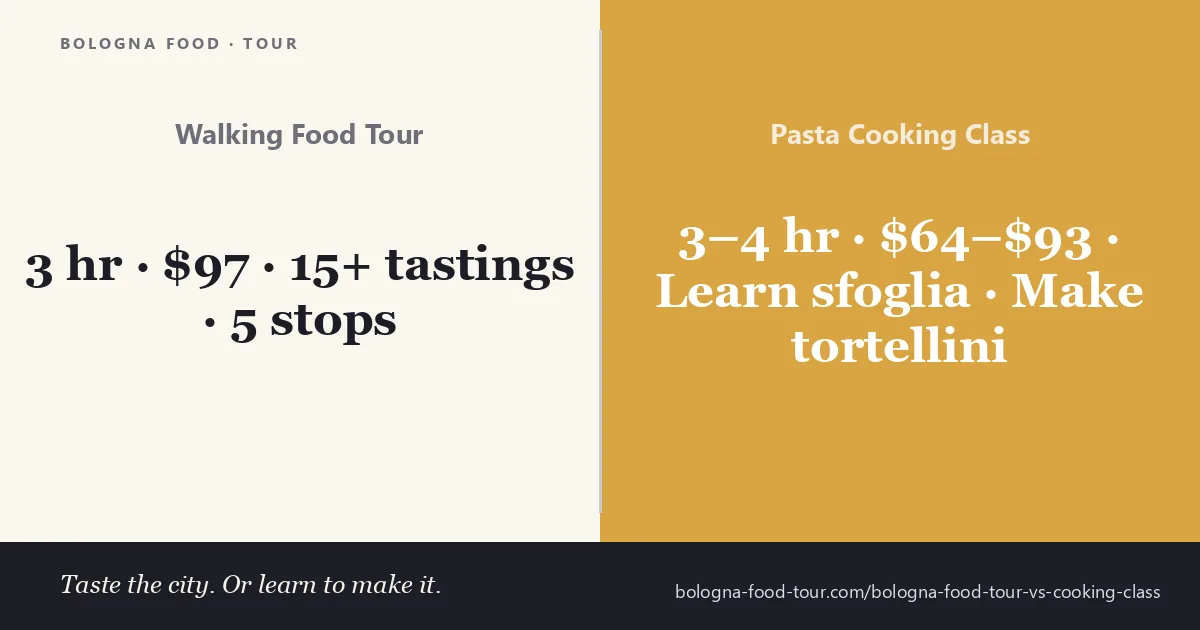
| Typical duration | 3 hours | 3–4 hours |
| Featured Bologna option (price) | Walking Food Tour with a Local Guide — $97 | Pasta Cooking Class with Wine — $64 to $93 depending on provider |
| Group size | Small (typically 4–12) | Small (typically 4–10) |
| What you take home | A tasting memory + guide’s restaurant list | Your own tortellini + the technique + the recipe |
| Best for | Breadth, first-timers, food explorers | Depth, returning visitors, hands-on learners |
| Walking required | Around 1.5–2 km over 3 hours | Minimal — single venue |
| Dietary flexibility | Limited (cured meats + cheese central) | Higher (egg pasta is the core; sauce can flex) |
| Wine included | Yes (Sangiovese, Pignoletto, Lambrusco at the city’s oldest osteria) | Usually 1–2 glasses |
| Weather independent | Yes — porticoes cover most of the route | Yes — indoor |
What Each Format Actually Delivers
The Walking Food Tour
The featured 3-hour Bologna walking food tour is structured as a progressive tasting across five local stops. You start with tigelle (small warm Apennine flatbreads) as a pre-aperitivo, then walk into the Quadrilatero for mortadella di Bologna IGP and 24-month Parmigiano-Reggiano DOP drizzled with 25-year Aceto Balsamico Tradizionale. There’s a wine stop at the city’s oldest osteria (the historic Osteria del Sole, in operation continuously since the 15th century), a fresh-pasta tasting of tortellini and tagliatelle at a trattoria, and a closing gelato. Total: 15+ tastings.
The walk itself is the underrated part. Three hours with a Bolognese guide gives you a reading of the Quadrilatero you can’t get from a guidebook — which salumeria is owned by the third generation of the family that started it, which sign on the wall actually means “tagliatelle here are made by hand at 6 a.m.”, which gelateria the locals queue at versus which is just well-located.
The Pasta Cooking Class
The featured-tour vendor (Tours and the City) runs a 3-hour Pasta Cooking Class with Ragu, Spritz, Wine & Gelato — currently rated 4.9/5 from 972 guests at around $81. Other providers (Cooking Italy at $64; La Mia Bologna at $93) offer similar 3–4 hour classes with slight variations: some focus on tortellini specifically, some on tagliatelle plus tiramisu, some on a full multi-course meal.
The skill you actually walk away with is the sfoglia — the thin, hand-rolled egg-pasta sheet that is the backbone of Bolognese cooking. You’ll learn the proportions (00 flour, eggs, a pinch of salt), the rolling technique with a mattarello (long thin rolling pin), and the cutting for tagliatelle, tortellini fold, and lasagna squares. Most classes finish with you eating the pasta you just made, paired with a sauce (often a real ragù alla bolognese — served on tagliatelle, never spaghetti). Most schools sell branded mattarelli as take-home souvenirs (€20–40); a few include a basic one in the class fee.
Named Operators Worth Knowing
A few schools come up repeatedly in Bologna and are worth searching for by name when you book direct rather than through aggregators:
- La Vecchia Scuola Bolognese — founded by Alessandra Spisni in 1993 and the city’s most famous pasta school. Spisni is a public-television personality (the long-running RAI show La Prova del Cuoco) and a Bolognese matriarch of sfoglia; the school runs hands-on classes for visitors and a more serious professional curriculum for sfogline-in-training. Class price €80–150 range. The annual Saggio delle Sfogline graduation demonstration is open to the public.
- Bluone — a long-running Bolognese food-and-wine outfit running cooking classes plus producer day trips into the surrounding province (acetaia visits, Parmigiano-Reggiano dairies, prosciutto stagionature). Premium positioning.
- Italian Days Food Experience — primarily a day-tour operator running the popular “Bologna and the Italian Food Valley” full-day producer trip (acetaia + Parmigiano-Reggiano caseificio + prosciutto producer + lunch). Cooking-class equivalent for people who want to see DOP/IGP production rather than learn to make pasta themselves.
- FICO Eataly World / Grand Tour Italia — the giant agroalimentare park east of the city centre. The original “FICO” version closed in early 2024 and the site reopened in September 2024 as Grand Tour Italia, a 50,000 m² park dedicated to all 20 Italian regions. As of 2026 it runs short cooking workshops, regional tastings, and producer visits on-site. It’s a side-trip experience, not a substitute for a city-center class or food tour.
Where Each Format Falls Short
The food tour doesn’t give you the technique. Three hours of tasting builds your palate and your shortlist but you cannot replicate sfoglia at home from a tasting tour.
The cooking class doesn’t give you the city. You’ll spend three hours indoors learning one excellent thing. You will not see the Quadrilatero, won’t taste the 25-year balsamic by the spoon, won’t try the cured-meats spectrum, and won’t get a curated restaurant shortlist for the rest of your stay.
Vegetarians: the food tour’s cured-meat backbone is hard to substitute (the tour’s own page notes the itinerary is not suitable for vegans and difficult for strict vegetarians). A cooking class skews vegetarian-friendly — egg pasta is the core, and most providers can swap a ragù lesson for a tomato-and-cheese filling or pesto.
Gluten-sensitive: both formats are challenging in Bologna. Egg pasta and tigelle are wheat-based. Some food-tour vendors can substitute a couple of stops; cooking classes are harder to adapt without making the lesson moot.
Can You Do Both?
Yes, and a lot of returning visitors do. The sequence matters:
- Food tour on day one anchors your sense of what Bolognese cooking actually tastes like — you’ll understand what a real ragù vs an Anglo “spaghetti bolognese” is, what 24-month versus 36-month Parmigiano taste like side-by-side, and what a 25-year DOP balsamic is doing on Parmigiano.
- Cooking class on day two or three then makes much more sense — you already have the reference flavours from yesterday.
The reverse order works too, but you’ll spend the cooking class wondering what the “real” version tastes like outside the kitchen.
Price Comparison
Five current Bologna food-tour and cooking-class options at a glance:
| Experience | Provider | Duration | Price | Rating / Reviews |
|---|---|---|---|---|
| Walking Food Tour with a Local Guide (featured) | Tours and the City | 3 hr | $97 | 4.8 / 1,629 |
| Pasta Cooking Class, Ragu, Spritz, Wine & Gelato | Tours and the City | 3 hr | $81 | 4.9 / 972 |
| Pasta and Tiramisu Cooking Class with Wine | Cooking Italy | 3 hr | $64 | 4.8 / 643 |
| Dinner, Wine & Tastings Walking Tour | Depetrini Tours | 3 hr | $92 | 4.8 / 145 |
| Guided Food Markets Tour | MyBologna.com | 2 hr | $49 | 4.8 / 77 |
All five offer free cancellation up to 24 hours before. A walking food tour plus a cooking class (booked separately) typically lands between $145 and $190 per person — a small premium over a single experience for substantially more depth.
A Note on Authenticity
Both formats teach you the same underlying fact about Bolognese (and more broadly Emilian-Romagnolo) cuisine: it is the most rigorously codified regional cuisine in Italy. The official ragù alla bolognese recipe is on file with the Bologna Chamber of Commerce (deposited in 1982 by the Bologna delegation of the Accademia Italiana della Cucina — see Ragù alla bolognese vs spaghetti bolognese for the full story). Tortellini have a registered shape and filling deposited with the Bologna Chamber of Commerce. Parmigiano-Reggiano DOP (Reg. UE 1107/96) is restricted to five provinces (Parma, Reggio Emilia, Modena, Bologna left of the Reno river, Mantova right of the Po), with aging tiers from 12 to 40+ months. Mortadella di Bologna IGP (Reg. UE 1549/98) covers Bologna and surrounding provinces. Aceto Balsamico Tradizionale di Modena DOP (Reg. UE 813/2000) is the long-aged barrel product — Affinato (red cap, minimum 12 years) and Extravecchio (gold cap, minimum 25 years), bottled in the distinctive 100 ml Giugiaro-designed phial. Worth noting culturally: balsamic tradizionale is a Modena product, not a Bologna one. Modena is the adjacent province, an easy 35-minute Frecciarossa hop, and any “balsamic acetaia visit” leaving Bologna is in fact a day trip into Modenese territory. Bolognesi are perfectly happy to taste it but rarely claim it as their own.
What “All-In” Actually Costs
A walking food tour at $97 includes every tasting, the wine pour, and the guide — there’s no on-day surprise spend unless you decide to buy souvenirs. A trattoria meal, by comparison, comes with a few small line items first-time visitors aren’t always told about:
- Coperto (“cover charge”) — a small per-person fee for bread, table linen, and the table itself. In Bologna 2026 this typically runs €1.50–3 per person (occasionally €4–5 at higher-end places on Piazza Maggiore). It is not a tip, it is not optional, and it is always listed on the menu.
- Acqua minerale — bottled water (frizzante or naturale) is the default; expect €2–4 per litre bottle. Tap water (acqua dal rubinetto) exists but isn’t always offered automatically.
- No automatic service charge — Italian restaurants don’t add a service line and tipping is not customary (a few euros for excellent service is appreciated).
- Cooking-class pricing is usually fully inclusive of pasta ingredients, wine, and the meal you eat — no coperto on top.
A walking food tour shows you these rules in the wild; a cooking class teaches you the rules from inside. Either way, you leave understanding why Bolognesi care so much.
Ready to Book?
The fast answer for most first-time visitors: book the featured Bologna walking food tour — 4.8/5 from 1,629 guests, 3 hours, 15+ tastings, free cancellation. Add a cooking class on day two if you’ve fallen for the city. Both formats are excellent in Bologna; what matters is matching the format to your trip.
Taste Bologna's La Grassa — 15+ Tastings, 5 Shops, 3 Hours
Join 1,629+ guests who rated this Bologna food tour 4.8/5. Mortadella di Bologna IGP, 24-month Parmigiano-Reggiano with 25-year balsamic, fresh tortellini, tigelle, and wine at the city's oldest osteria — all with a Bolognese local guide who knows every shopkeeper. Free cancellation up to 24 hours before.
Check Availability & Book